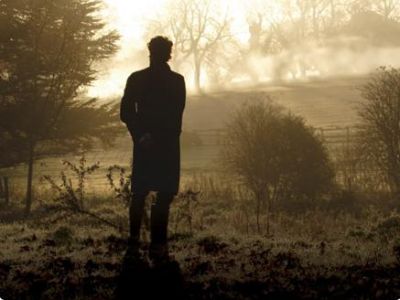
That’s it. I’m doomed. DOOMED. It seems that tall, dark, handsome brooding men are my type. First, Bruce Wayne a.k.a. the Batman that has left a many young heroines broken hearted (though in my universe, I pair him with Diana of Themyscira, the Wonder Woman, to many fans’ approval!). Then, before I even finish with a sensitive Irish rake/pious young lad (depends on which version of Tom Lefroy you prefer: James McAvoy’s in Becoming Jane or the real one), I bumped into another tall, dark, handsome brooding gentleman. This time, he’s John Thornton, a Milton mill owner, up in the north industrialised side of England. And boy oh boy, was he not delicious?!
 Perhaps, I should start from the beginning. Ehm. Neglecting the fact that I should be doing some works for the weekend (and that I should save my account from bankruptcy), I walked into Angus & Robertson (yes, the very place I bought my Shakespeare Retold: Macbeth, in which my dear tall-dark-handsome-brooding Thornton played as Peter MacDuff) and, after starring at a Wolverine-like gentleman in Victorian clothing on a DVD cover, I snatched that said DVD and brought it home, feeling rather sorry for myself for spending an extra $30.
Still thinking of my unplanned purchase, I placed the North & South (2004) DVD. After a few scenes of green English countryside, the film moved towards grey areas of Milton, one of the centres for cotton industry in England. There, I saw the tall dark handsome brooding John Thornton (Richard Armitage) chasing his worker and pummelled him into half stew. I began to have a mixed feeling of distaste and sensations towards the ‘nasty’ mill owner, the way Miss Margaret Hale (Daniela Denby-Ashe) saw him for the first time.
Miss Hale was in fact the Victorian Elizabeth Bennet with less sharp tongue (but not less opinionated mind) with much smaller family (with a cute brave brother, but thank God: no senseless, idiotic sisters) who moved from Helstone in Hampshire (!) to a fictional town called Milton, somewhere in northern England, closer to Scotland. I cannot blame her for her negative opinions towards Thornton, for she did saw him beating his employee and also did not show empathy towards the workers’ life. Moreover, when a strike truly happened (in demand of a payroll rise), Thornton imported Irish workers to replace his workers. He even criticised Margaret for giving food to the children of the strikers on the argument that it would prolong the strike, and hence did the workers no good. What a rude, heartless rake! And his unsustainable factory that polluted the Milton river! Environmental crime!

But we, Margaret and I, were wrong. It turned out that Thornton punched his worker for smoking inside the cotton mill; whereas smoking was strictly prohibited due to incidental fire in the mill several years ago that killed many workers (this scene was not in the original novel, but I think it was a bloody brilliant idea!). Plus, Thornton’s Marlborough Mills was not in a good shape; hence salary raise was not an effective choice at that time. In the mid of Episode One, Margaret learned that Thornton was not a rich man by birth; he had to climb his way up the ladder not without bruises and cuts. Margaret (and I) began to respect him and saw him in a different light. By the half of the first BBC episode (there are 4 of them), as my hero visited my dosing heroine at her new home in Milton… and saw how he brushed her slender fingers (accidentally, of course) as he received the tea she offered, my heart melted. And all the way, all along the episodes… I cannot help falling in love with Richard Armitage’s John Thornton. As for the pollutions caused by cotton mills... well, John Thornton was not the only guilty Victorian men in this case...

But of course, as in all love stories, things did not go smoothly between Thornton and me... I mean, Margaret. Almost the Victorian Pride & Prejudice in the rocky love story between a lady and a gentleman, North & SouthThornton could not easily snug Margaret. Granted, he was interested in her the first time he saw her (Heh… how could he not? I think Daniela was the perfect Miss Hale). But she saw him for the first time not in his best light, and that image ruined her initial interest in him. Thornton’s attitudes during the strike also did not please Margaret (despite him being so worried after she took a blow during the riot to save him). The climax of Episode Two was Thornton’s proposal to Margaret, driven by his love for him (and believing that she protected him due to her love for him). Like PP’s Lizzy Bennet, Margaret refused Thornton’s proposal. And like PP’s Darcy, the stupid Thornton just got angry and ‘chased’ Margaret around the table, demanding explanation. You would have though Thornton read Pride & Prejudice… but oh well…Episode Two ended with sorrow to our lover birds.
Episode Three came with Mrs. Hale’s worse condition. To lessen her mother’s anxiety, Margaret had invited Brother Frederick secretly from Spain. He came one night in secret and stayed in Milton for several days. Mrs. Hale eventually passed away, but before her funeral, Fred ought to leave the country again, lest someone would recognise him. Margaret took Fred to the station before midnight, and as a farewell, of course they embraced. Alas, handsome and jealous Mr. Thornton was in sight. He was very surprised to see the utter show of impropriety, but chose not to say anything and left. A worse thing happened as a man (Leonard) recognised Frederick. Fred and Leonard fought; the drunken Leonard fell and Fred got away. Bye bye. Not.

For Leonard died, and an investigation was done to examine the cause of death. Someone else saw Margaret during the Leonard fight, hence , Police Inspector Mason, had to interrogate Margaret who of course denied her presence at the station. Consequently, Mason consulted the local magistrate, who was none other than John Thornton. Though surprised that Margaret concealed the fact that she had been at the station with ‘a stranger’, Thornton helped her by closing down the investigation, under the argument of insufficient medical evidence. He did not reduce his bitterness towards Margaret though, and that made her suffer, for she had changed her opinions on Thornton and did not wish him to think bad of her.
Many interesting things happened in Episode Four, the last episode of the excellent BBC miniseries. First, about Nicholas Higgins (Brendan Coyle), a good friend of Margaret, also the father of Bessy Higgins, Margaret’s close friend in Milton (Bessy died in Episode Three; Anna Maxwell Martin played her well, just as she played Cassandra Austen in Becoming Jane). Nicholas had been adamant not to work again at any mills, but upon the death of Boucher (one of the workers), he felt responsible and took Boucher’s six children. Thus, Nicholas needed fresh cash. And, after being persuaded by Margaret, he swallowed his pride and asked for Thornton to give him job. Of course, Thornton refused him. But upon several inquiries, the mill owner realised that Nicholas was telling the truth. After a touchy visit to Nicholas’ shabby house, Thornton agreed to give him a job. The tall, dark, handsome brooding Thornton also finally realised that Margaret was the one who persuaded Nicholas to ask for job.

Nicholas and Thornton experienced interesting shifts in their relationship. First: enemies. Second: master-worker. Then, after Thornton took extra attention to one of Nick’s adopted son, Nick started to change his opinions. After Thornton suggested a food scheme that enabled workers to have their food together in a factory canteen, their relationship steered towards friendship. It was Nicholas who told Thornton of Mr. Hale’s death (Mr. Hale was visiting Oxford). It was also Nicholas who told Thornton of Margaret’s brother. In fact, Nicholas-Thornton association was one of the best relationships I enjoy in NS (The other one was Thornton-Mrs. Thornton and, of course, Thornton-Margaret). When Nicholas bade Thornton farewell (after the down of the Mill), they parted as good friends. I like to think that Thornton would later take Nicholas under his wing again, and very likely to offer him a better position.

And what of Margaret? Well, her mother passed away, also later her father. She was left an orphan, but a rich one nonetheless, for Mr. Bell (her godfather) left her a huge amount of money. In the end, she was the one who saved Thornton’s mill from bankruptcy, but not before a painful farewell under the falling snow (for she would need to move to London first), and not before Thornton’s romantic visit to Helstone, just to inhale the breeze of Margaret’s childhood place and accidentally picked her favourite yellow rose. The last scene at the Midland Central Station was the one of the most romantic scenes, where our hero and heroine accidentally met and shared a sweet tender kiss on the platform. Who says that a tender kiss is not sexy?! It’s effectively making you wanting for more, not unlike the scene where Jane Austen (Anne Hathaway) and Tom Lefroy (James McAvoy) almost shared a kiss under the candle light in London.


Authoress Elizabeth Gaskell (who eerily looked like Mrs. Hale) might have based Margaret on Jane Austen’s Lizzy Bennet (and Thornton on Fitzwilliam Darcy), but North & South (1854) is considerably a different story from Pride & Prejudice (1813) altogether. PP is much more merry and shiny than NS, and I have to admit that, though I love Lizzy Bennet (Jennifer Ehle’s version), I never truly enjoyed Mr. Darcy (not even the combination of Colin Firth’s brooding and Matthew Macfayden’s sensitivity). I guess, Darcy is not my brooding type after all.
But John Thornton! Gosh… if I’m falling head over knee like this over Richard Armitage’s Thornton (what a name… Armitage, Thornton…), what will I do if I watch the 1975 version where Patrick Steward (of all people!) was Thornton? Swoon. Plus, Thornton was shown to care for his workers. I know that Darcy’s friends, family and servants said that he was a very good master (don’t kill me Jane friends!), but watching Thornton caring for Nicholas, the poor little girl at the alley, and little Tom as the kid read a book on a comical an-i-mal just melts my heart…

Did I say that I spent AUD 30 for the four episodes, double DVD? Though I had felt rather sorry for spending money in the first place, in the end I did not regret it. Never, never, never. NS 2004 is one of the best costume dramas I’ve ever seen. I have to say that it’s on par with Becoming Jane. Yes, even the intense chemistry between Margaret & Thornton, though not in the same speed and turbulence with Jane/Tom... the Margaret/Thornton chemistry was certainly very intense, and I could not think of another Margaret other than Daniela's. God knows how many tissues I needed last night (and this morning for the replay) to clean my face from the tears that ran erratically during the four-hours show. Conclusion: watch it if you have not, and if you can, buy the DVD. Never a bad decision. In fact, like Becoming Jane, I might buy the second copy myself for precaution!
See also: Foolish Passion, a cool North & South fansite! And don't forget to read this very hilarious imaginary conversation between Darcy and Thornton. I laughed out loud as I read it. Too funny!
PS2: Thanks to Montevideana for this link of a cheeky virtual conversation between Lizzy Bennet and Margaret Hale. I agree with the writer that Lizzy/Darcy should double date with Margaret/Thornton!
Pic 1: John Thornton (Richard Armitage), from Richard Armitage Online
Pic 2: DVD cover to North & South 2004, Sofa Cinema UK
Pic 3: John Thornton amidst the snowy cotton, from Richard Armitage Online
Pic 4: Margaret Hale (Daniela Denby-Ashe), from Wikipedia
Pic 5: North & South BBC banner, from BBC UK
Pic 6: Nicholas Higgins (Brendan Coyle) and John Thornton. From Richard Armitage Online
Pic 7: Farewell under the snow fall, from Richard Armitage Online
Pic 8: Prelude to the final kiss, from Richard Armitage Online
Pic 9: The final KISS at the station! From Richard Armitage Online
Pic 10: Going back to Milton together. From Richard Armitage Online